The UK government hopes to get more firms to use AI, in the expectation that productivity gains will follow. Professional services firms are natural candidates to adopt AI because of the nature of their work. In a new survey, Dr John Lourenze Poquiz, Dr Aleks Turobov and Dr Nina Jörden found that two in five are already using AI but nearly half say no government policy intervention would change their current plans. The main barrier they cite is lack of clarity on liability. Safe harbour provisions and guidance on professional liability for AI-assisted work come first in their list of asks, ahead of policies such as grants and tax relief.

When identifying the productivity and labour-market effects of AI, the usual assumption is that the professional services1 sector is where they should show up first. Work within this sector tends to be knowledge-intensive and cognitive. It is heavy on drafting, research, and analysis – the types of tasks where large language models perform best. Thus, this sector is a good testing ground for exploring how AI will show up in measured productivity.
Figure 1: Stated use of AI in professional services
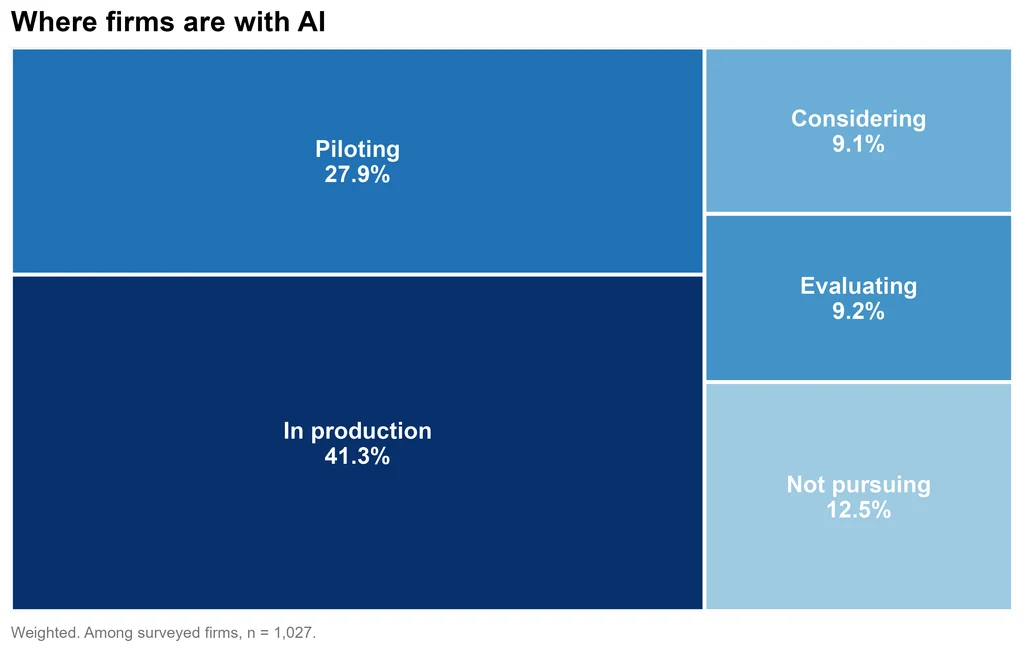
So far, the sector has outperformed the wider economy on productivity, though not by as much as the task-level evidence would imply. The standard explanation is that adoption is still low, and that diffusion simply takes time. However, new evidence from our recent survey suggests that adoption in professional services in the UK is already quite high (figure 1). Rather, the main barriers are data quality, AI reliability, and professional liability.
We asked 1,027 senior decision-makers2 across UK professional services firms where they stand on AI adoption. Seven in ten said that they are already using AI in production or are piloting it. This means firms are already navigating the emerging terrain in AI adoption, but something else is limiting how much value they can extract from the technology.
Figure 2: Factors affecting decision to invest in AI
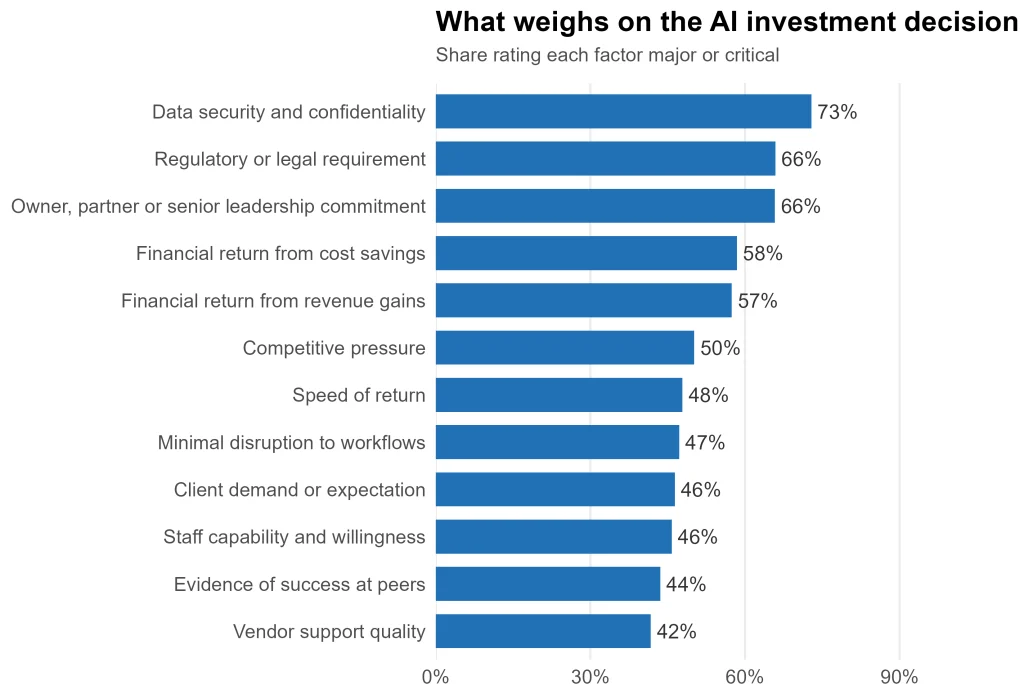
We asked firms the degree of which a range of factors affect their decision to adopt AI (see figure 2). Data security and confidentiality was rated a major or critical factor by 73% of firms, and regulatory or legal requirements by 66%. Both sit above the financial considerations, which include cost savings (58%), revenue gains (57%), and the speed of financial returns (48%). This implies that the main driver of their decision to invest in the technology is whether they can use it safely and lawfully, or are exposed to legal risk.
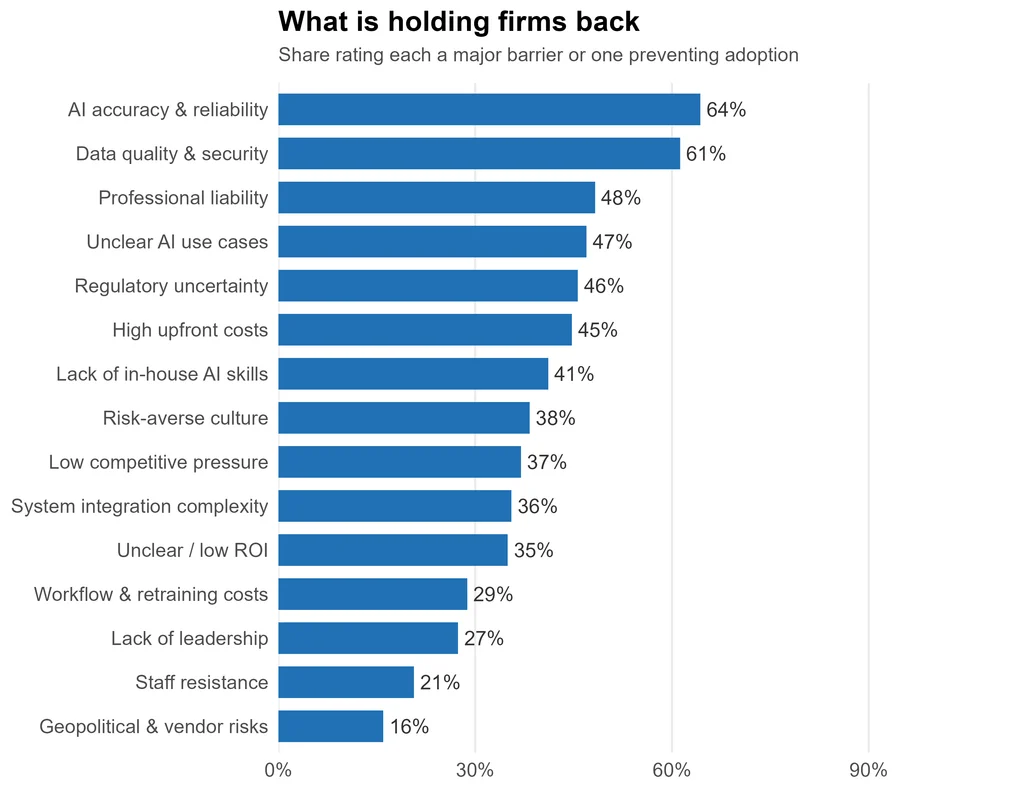
Among firms not yet using AI, “AI accuracy and reliability” was rated as the most important barrier (see Figure 3) preventing adoption by 64% of firms. Data quality and security was cited as a major barrier by 61% firms, and professional liability by 48%. The factors commonly identified as explanations for slow adoption sit at the bottom of the list, with workflow and retraining costs at 29%, lack of leadership at 27%, staff resistance at 21%. These results suggest, this is not primarily a story of workers resisting AI. The main barriers concern whether firms can use AI reliably, securely and with clear professional accountability.
Figure 3: Barriers to AI adoption
Accountability matters a lot for this industry. Solicitors carry duties to the courts and all lawyers require compulsory indemnity cover. Accountants are legally liable for the audits they sign off. Architects and engineers are governed by industry standards. Any error in these industries can quickly lead to lawsuits and insurance claims, and the absence of accountability in AI, along with a lack of professional standards for deployment, prevents wider adoption.
These results may also explain why management practices are related to AI adoption so consistently in both US and UK firm-level evidence. Verifying that AI output can be relied on is itself an organisational capability, and structured processes are required to enforce it.
Organisational capability also seems to matter on the financial aspects, though: a majority of respondents said demonstrable cost savings or revenue gains are the main considerations when deciding whether to invest. Yet among respondents describing their most consequential recent technology implementation, 48% report that no revenue target was set and 43% report no cost-reduction target. The gap is particularly pronounced among micro firms, suggesting that the organisational and financial capacity to manage AI investment may itself be unevenly distributed across firms, with larger ones more capable. So, financial returns matter a lot in principle, but benefit measurement is often surprisingly informal in practice.
Figure 4: Expected returns given organisational disruption
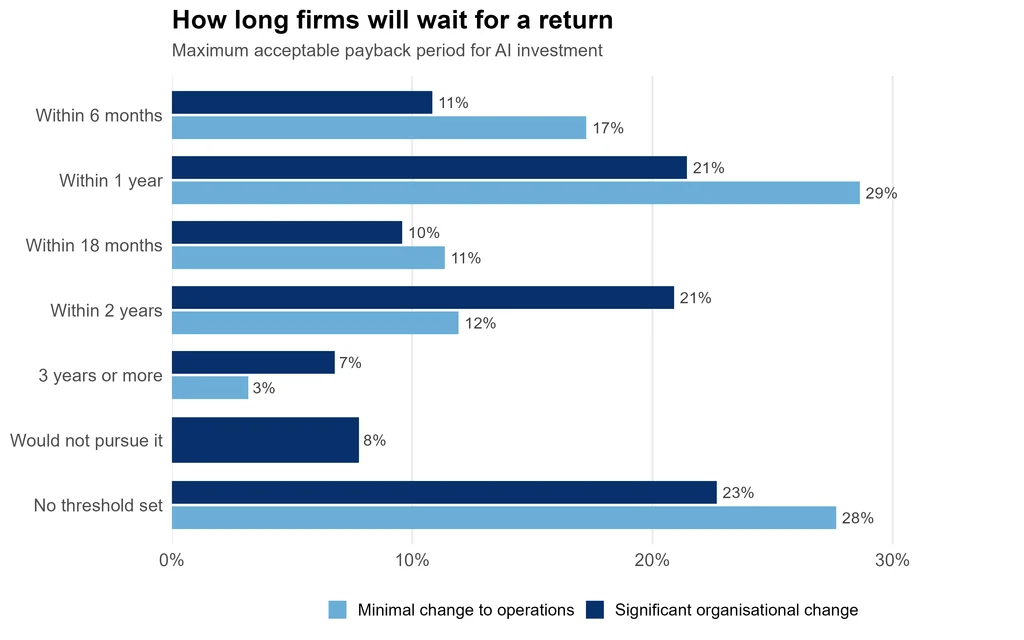
When looking at financial expectations, organisations are demanding a rapid return on their AI investments, but their expectations depend on the disruption they face (see Figure 4). If AI adoption would only require minimal changes to their workflow (e.g. new software, brief training), nearly half of the firms expect to see a return on investment within a single year (17% within 6 months, and 29% within a year). Meanwhile, when an AI initiative demands significant organisational change (e,.g. Team restructuring, workflow redesign), the timeline shifts slightly outward, with 21% of firms willing to wait up to two years for a return.
Interestingly, a substantial share of respondents (28% for minimal change and 23% for significant change) have not set a payback-period threshold. Furthermore, very few firms are willing to play the long game. Only 7% would wait three years or more for a project requiring significant change, while only 3% would wait that long if the required organisational restructuring is minimal.
In the survey, we also asked firms what policies would actually change their AI adoption timelines (see Figure 5). Nearly half said nothing would, as they see barriers as internal challenges. Among those who named possible interventions, the largest ask was regulatory clarity and liability guidance (16%), ahead of financial incentives (12%).
Figure 5: Policy support required to promote AI adoption
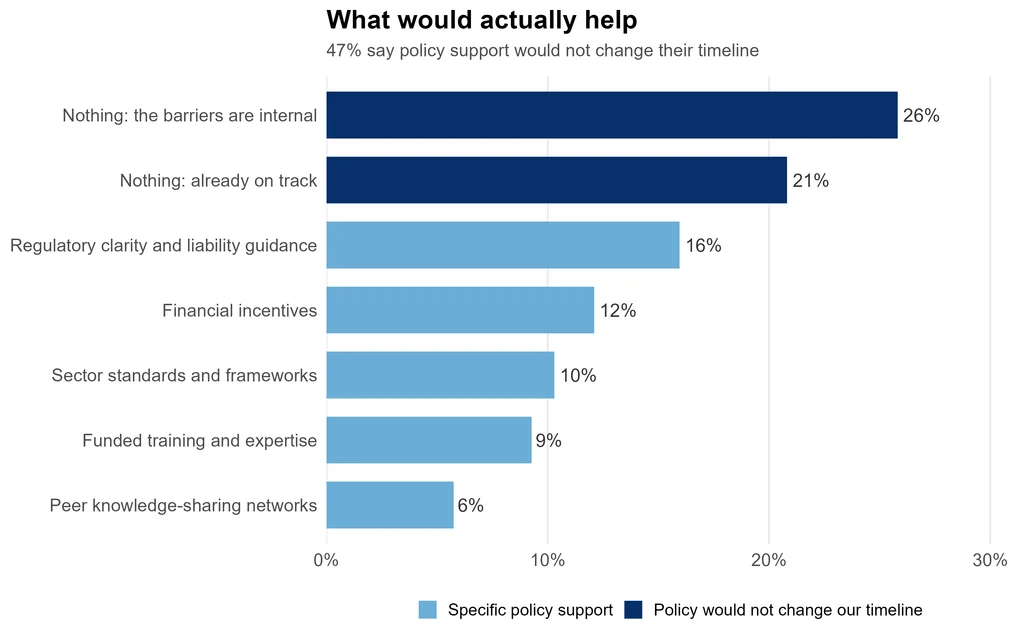
The results suggest that if the government wants to promote AI as a source of growth, it should avoid blanket regulatory approaches and instead empower professional bodies to set clear safe-use standards on liability and safe use. Policy must shift from pushing AI adoption to supporting internal governance and quality standards, giving firms the targeted confidence needed to translate high usage into real productivity gains, and as necessary supporting clarity about liability with an appropriate regulatory framework.
A technical report we will publish in November sets out the full descriptive results of our survey, including how barriers vary by firm size, what firms report about implementations that did not go to plan, and how long they will wait for returns when AI requires reorganising the work.
This research was supported by the Productivity Institute under ESRC grant ES/V002740/1. The survey of 1,027 firms was carried out by YouGov from the 10th of August up to the first week of September.
[1] We define professional services using the standard statistical classification, Section M of the UK Standard Industrial Classification (Professional, Scientific and Technical Activities). This covers legal and accounting services, management consultancy, architecture and engineering, advertising and market research, and related activities.
[2] The survey was administered by YouGov.
The views and opinions expressed in this post are those of the author(s) and not necessarily those of the Bennett School of Public Policy.